Quote with confidence, not caveats.
Sales Estimator Assistant gives your salespeople the engineering knowledge they need to configure, price and quote accurately. Without waiting for engineering.
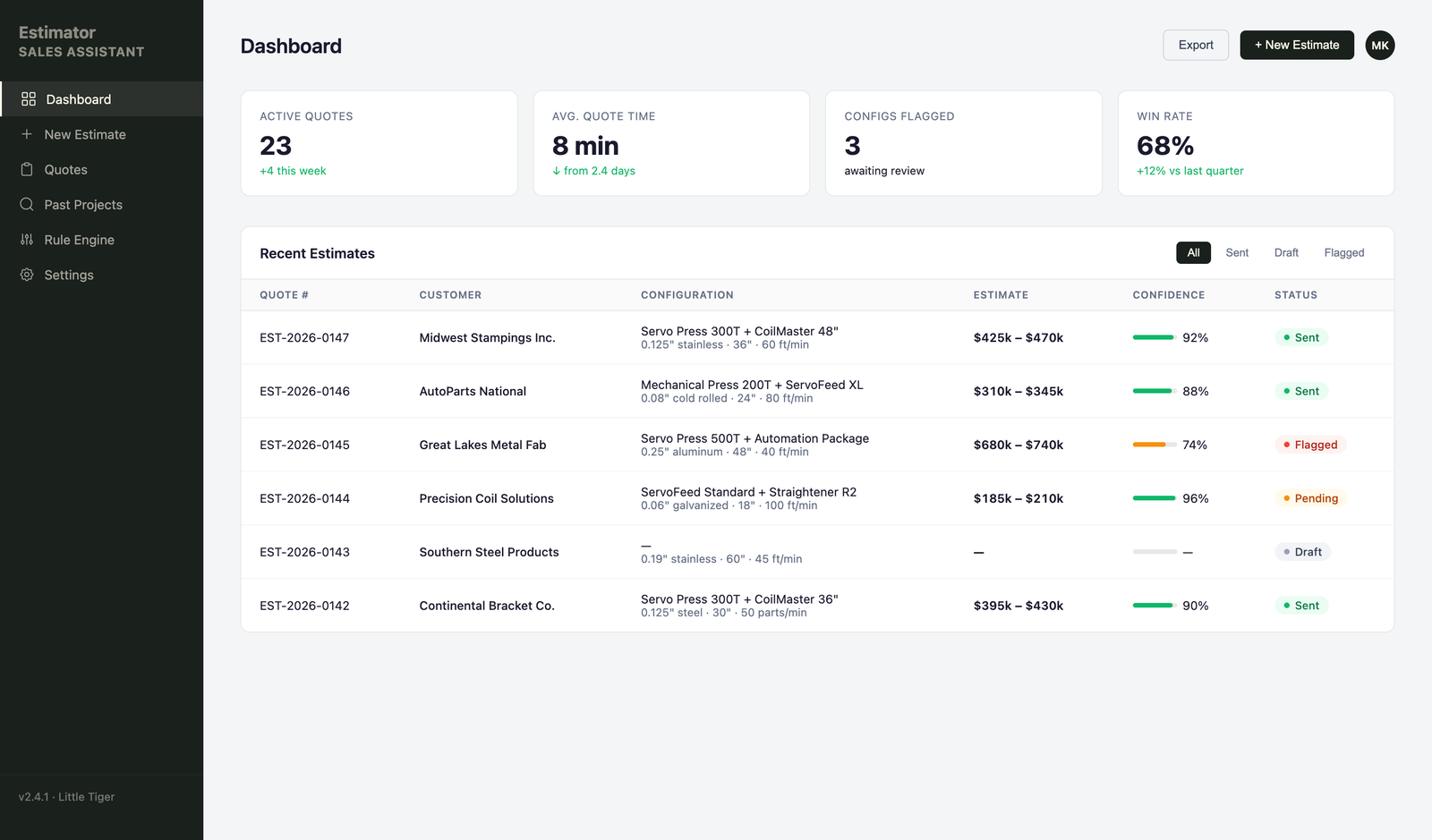

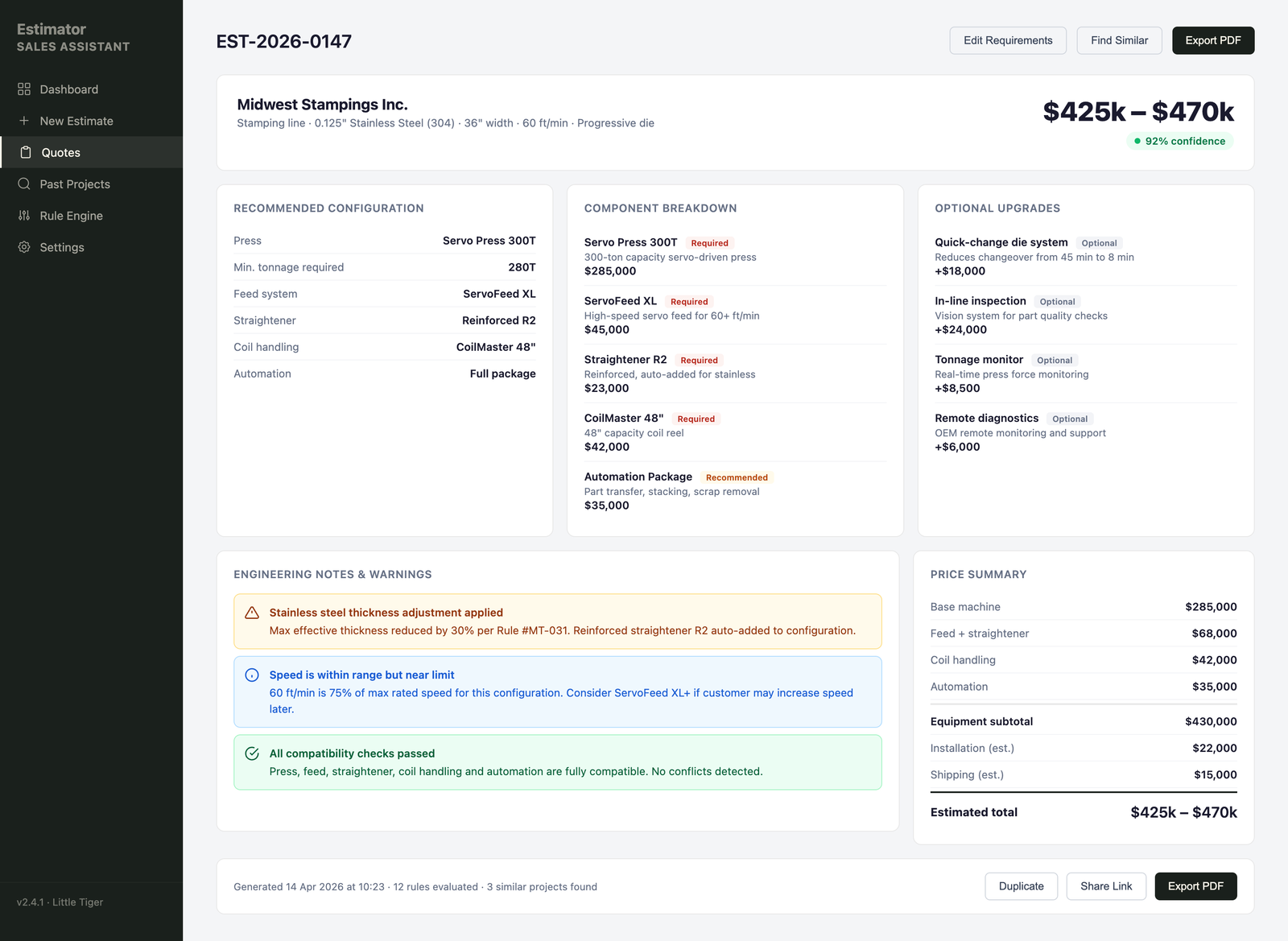
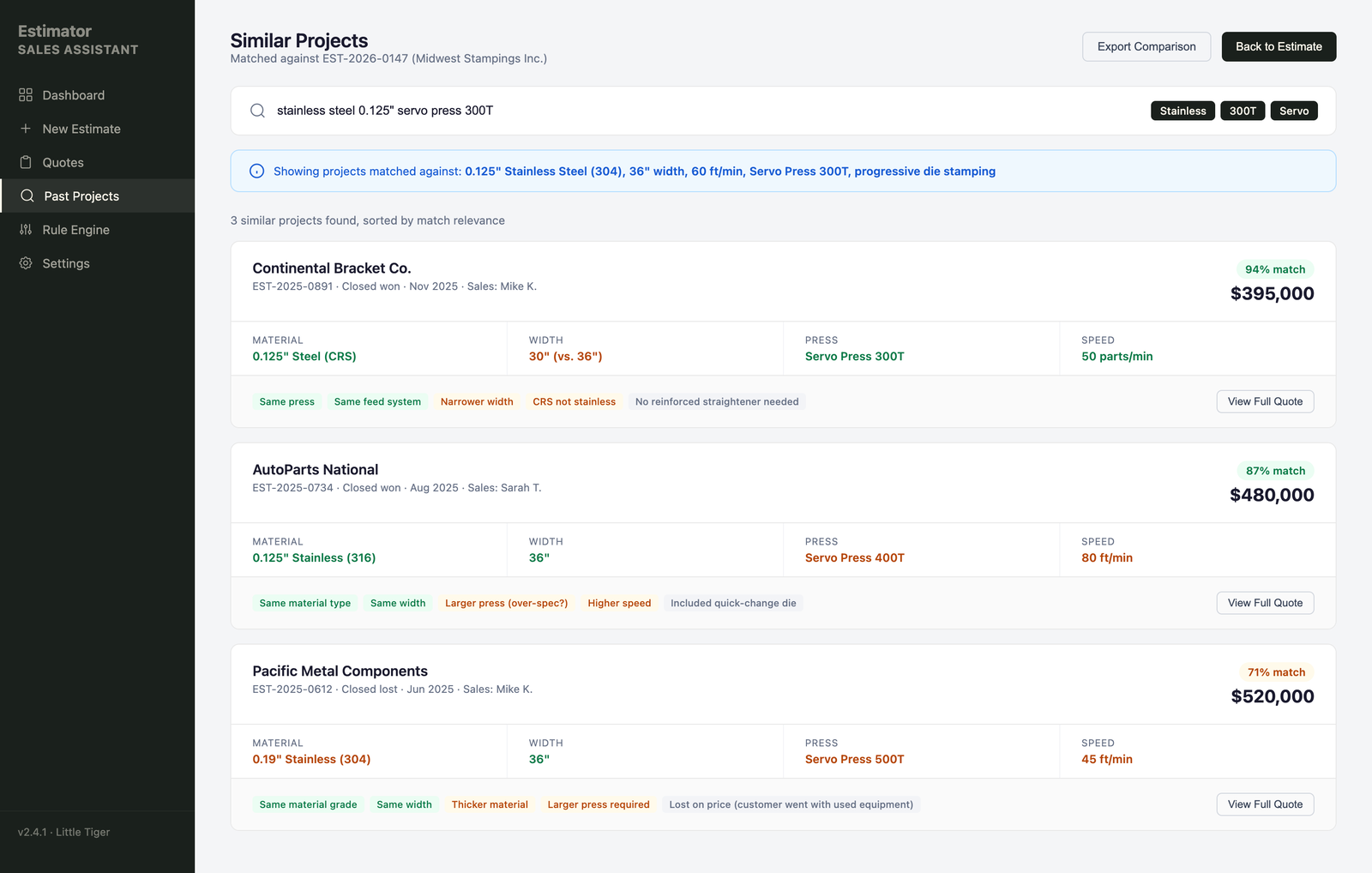
Configuration, estimation, validation and past project matching in one interface.
The problem
Three things that cost you money every week
Salespeople don't know what's valid
Customer wants 0.125" stainless at 36" wide and 60 ft/min. What press tonnage? Servo or mechanical feed? Which coil reel? That knowledge lives in spreadsheets, old PDFs and the heads of two engineers who've been doing this for 30 years. Your sales team is guessing, then asking, then waiting.
Every quote is a relay race
Customer request goes to sales. Sales guesses a configuration. Engineering reviews it, flags problems, sends it back. Someone opens a spreadsheet. Prices get assembled by hand. Revisions happen. A quote that should take minutes takes days. Customers don't wait that long.
Sales promises what engineering can't build
Insufficient tonnage. Incompatible automation. Impossible speeds. When sales commits to a configuration the machine can't deliver, you get lost margin, redesign work and a customer who won't call you next time.
The core issue
Your quoting knowledge lives in four places. None of them talk to each other.
Every manufacturer we've spoken to has the same setup. The information your sales team needs to quote accurately is scattered across tools, documents, people and history. The Estimator pulls it all into one system and makes it reliable.
What we replace
Excel calculators
Formulas that nobody remembers building, shared on a network drive, version-unknown. The Estimator encodes this as a rule engine: structured, testable and always current. When a rule changes, it changes everywhere.
Senior engineers' heads
The person who knows that stainless at 0.125" needs a reinforced straightener, or that 80 ft/min means servo feed. That knowledge gets captured as system logic while they're still around to verify it. It doesn't retire, go on holiday or get pulled into another project.
Internal PDFs and documents
Spec sheets, capacity charts, compatibility tables buried in folders nobody browses. The Estimator makes this searchable and connected. When a salesperson enters requirements, the relevant constraints surface automatically.
Manual Lookups of Previous quotes
The best reference for a new quote is a similar one you've already won. The Estimator indexes every past project and matches them to new requests automatically. Material, thickness, press type, price point: all searchable, all comparable.
What SEA does
Built around how you already work
Most quoting software wants you to change your process. Learn a new workflow. Reorganise your product catalog to fit their data model. Retrain your sales team on someone else's idea of how quoting should work.
We do the opposite. During deployment, we sit down with your engineers and map the rules, constraints and pricing logic you already use. Your machine families. Your component compatibility. Your markup structure. The Estimator gets configured to match how your team actually quotes, not how a software vendor thinks they should.
If your salespeople price by component, it prices by component. If they work from bundles, it works from bundles. If engineering approval is required above a certain tonnage, the system knows that. Your process stays yours. The Estimator just makes it faster and harder to get wrong.
On the go
Works where your sales team works
Your salespeople aren't always at a desk. They're on the factory floor with a customer, at a trade show answering questions between handshakes, or sitting in a client's office trying to give a straight answer on the spot.
The Estimator runs on any device with a browser. Phone, tablet, laptop. Same interface, same rules, same pricing. Instead of "let me get back to you," your rep pulls up the configurator, walks through the options and hands over a validated estimate before the meeting ends.
A quote that arrives three days late is a quote someone else already beat you to.
Full configuration from a phone
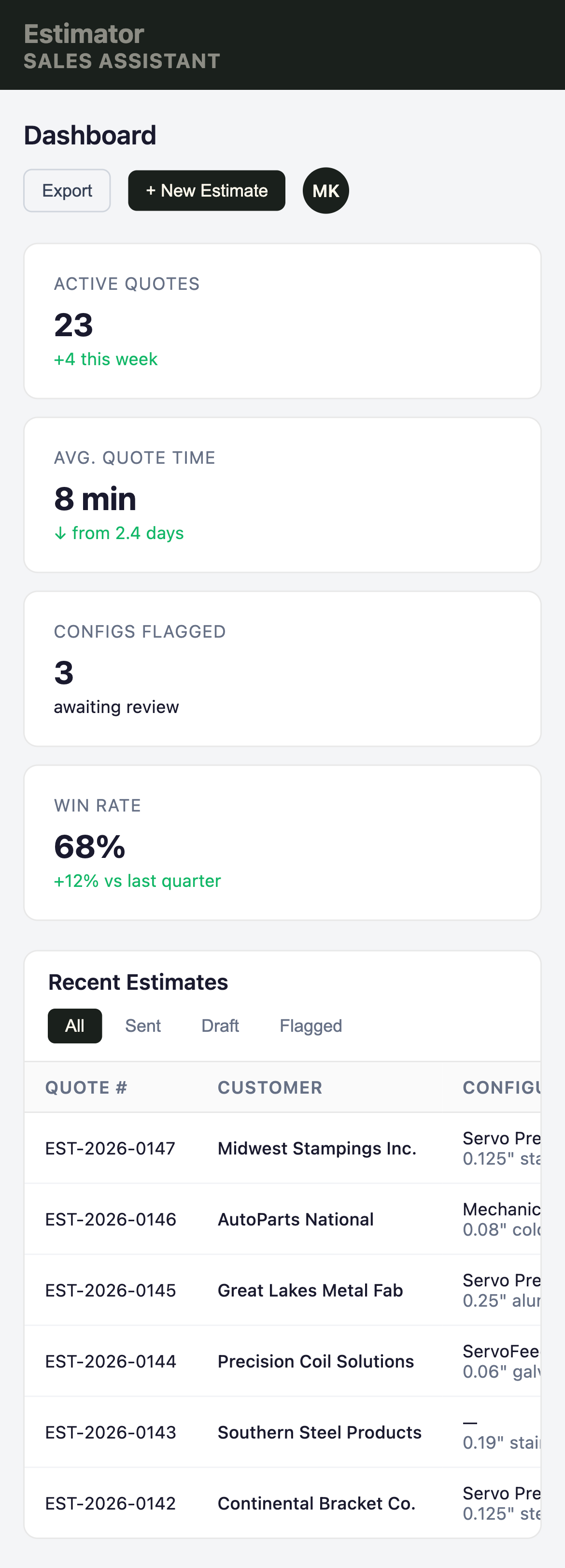
All your quotes, anywhere
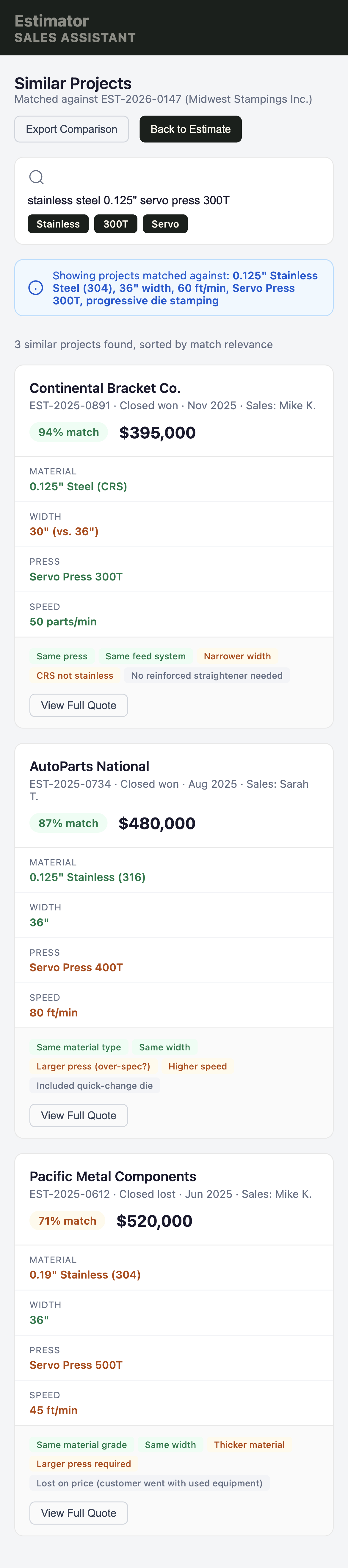
Validated estimates on the spot
How it works
01Enter requirements
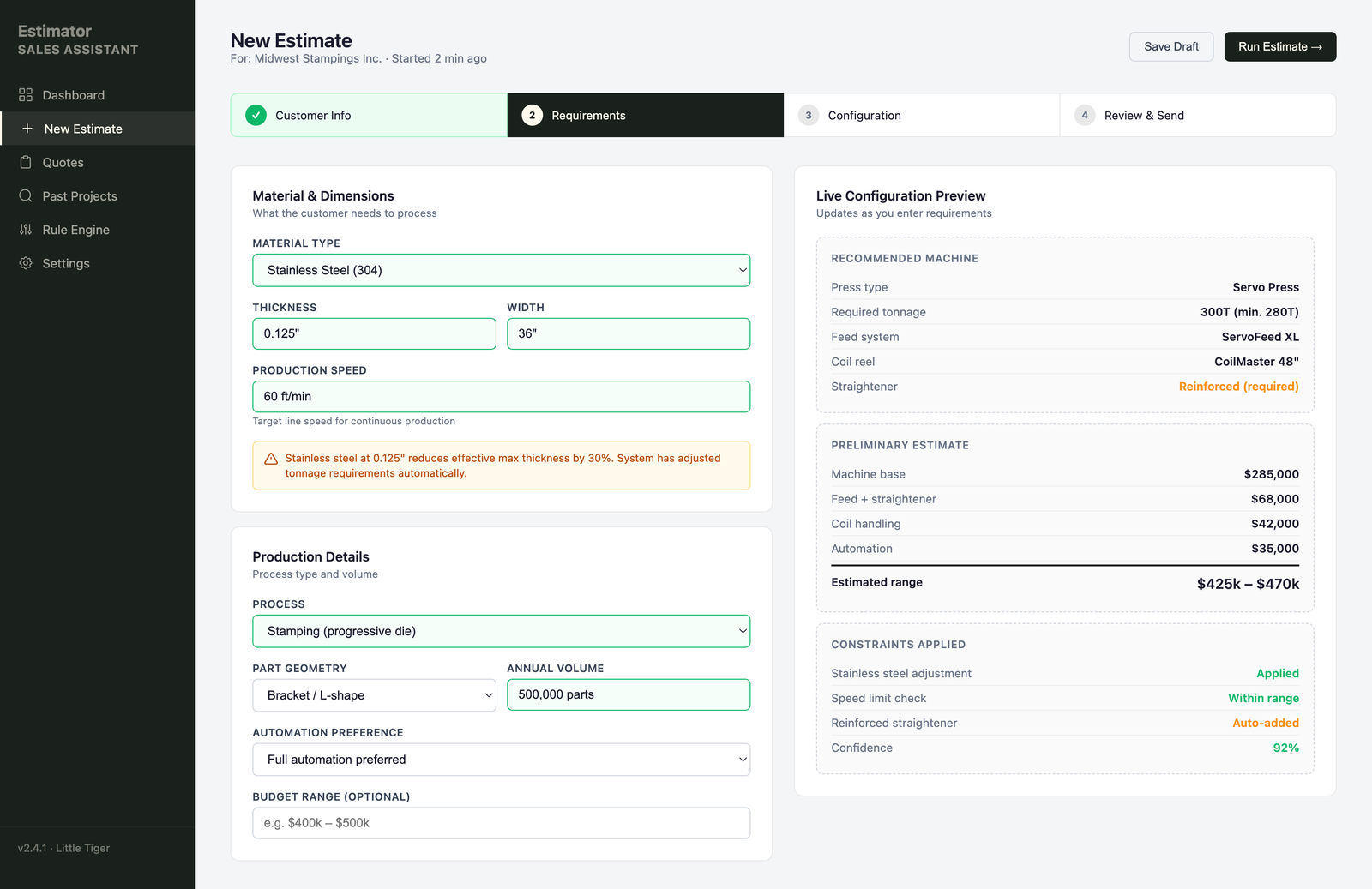
Salesperson inputs what the customer needs. Material, thickness, width, production rate, part geometry, budget range.
02System reasons
The rule engine evaluates constraints, determines minimum viable machine, checks component compatibility and flags anything that doesn't work.
03Get your answer
Recommended configuration. Estimated price range. Required components. Optional upgrades. Confidence level. Warnings where they matter.
The estimator interface: requirements on the left, configuration in the centre, pricing and warnings on the right.
The knowledge problem nobody talks about
Most manufacturers are quietly terrified of the same thing. The two or three senior engineers who know which configurations actually work, which specs are realistic and which combinations will fail in the field. They're retiring. And they're taking 30 years of institutional knowledge with them.
Sales Estimator Assistant captures that logic while those people are still around to encode it. Every rule, every constraint, every edge case. Preserved as system logic that works the same way whether it's Tuesday morning or three years from now.
The estimator is useful today. The knowledge base it builds is worth more than the tool itself.
What changes
Quotes in minutes, not days
Sales configures and prices without waiting for engineering to check their work.
Zero invalid configurations
The rule engine catches conflicts before they reach the customer.
Institutional knowledge preserved
Engineering expertise encoded in the system. Doesn't retire, doesn't forget, doesn't take holidays.
Sales teams that sell more
Faster quotes, fewer revisions, more time in front of customers.
Get in early. Pay less.
We're opening Sales Estimator Assistant to a small group of manufacturers who want to move first. Early access comes with a reduced deployment cost and direct input into what we build next. If your sales team is quoting blind and your engineers are tired of fixing it, this is the conversation to have.